
Good design should do more than look good.
A strong visual can make someone stop scrolling, but attention alone is not the finish line.
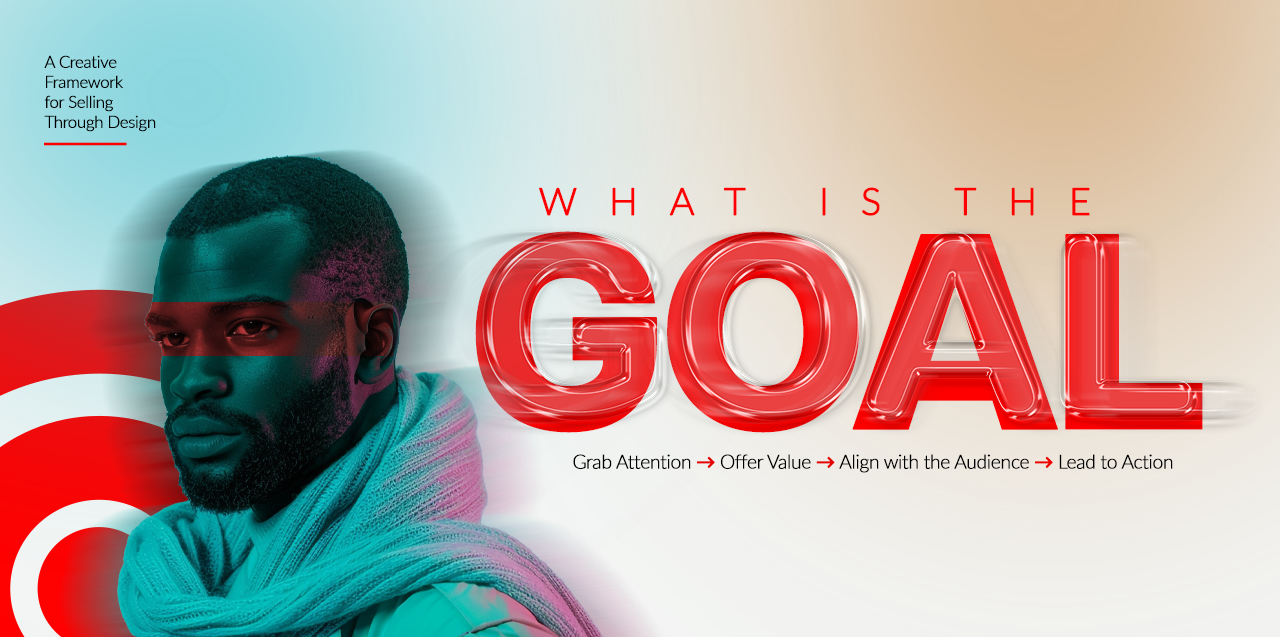
Marketing has to explain why a product matters, connect that value to the right people, and make the next step clear. That is the idea behind GOAL.
GOAL is not a style guide. It is a decision filter. You can use it while creating a social graphic, a 30-second video, a landing page, packaging, a trade-show display, an email campaign, or a full product launch.
Before making something beautiful, ask what job it must do.
Grab Attention
People move quickly through feeds, stores, websites and public spaces. The first job of the creative is to interrupt that movement long enough for the message to register. In graphic design, that may come from a bold headline, a surprising crop, contrast, scale, color or a strong focal point. In video, it may be motion in the first second, a visual reveal, a provocative question, or the product already in use.
Graphic thinking
Build one dominant focal point instead of making every
element equally loud.
Use contrast to separate the message from its environment.
Write headlines that can be understood before the supporting
copy is read.
Video thinking
Open with the most interesting moment, not a logo animation.
Show the product, problem or result quickly.
Use movement and sound

Offer Value
Once you have attention, answer the question: Why should I care?
A product can have dozens of features, but customers usually remember the benefit that solves their problem. Good marketing translates features into useful outcomes. Instead of saying only that a battery lasts 30 minutes, explain what that means: enough time to finish the task without stopping to recharge.
Graphic thinking
Turn features into benefits.
Use short benefit-led headlines, comparison graphics, icons, product demonstrations and before/after storytelling. Reduce the message until the value
is obvious at a glance
Video thinking
Show the value happening.
Demonstration is often stronger than explanation.
Show the product removing friction, saving time, improving an outcome
|If the audience remembers only one sentence, make sure that sentence explains the value.

Align With the Audience
Make the message feel like it was created for the people you want to reach.
Strong creative is not only about what the brand wants to say. It is also about how the audience sees the world. Alignment influences the language, casting, photography, color, typography, music, pacing, platforms and cultural references used in a campaign.
Ask before designing
- What problem is this audience trying to solve?
- What does success look like in their life?
- What language do they use when describing the need?
- Where will they encounter the message?
Then shape the creative
- Choose imagery that reflects the audience and the desired experience.
- Match the pace and tone to the platform and context.
- Use proof points that matter to this audience, not simply what is easiest for the brand to say.

Lead the Action
Turn interest into a clear, low-friction next step.
A call to action is more than a button that says Shop Now. The entire experience should make the decision easier. Visual hierarchy should move the eye from the headline to the product to the reason to believe to the next step. In video, the ending should make the action feel like the natural conclusion to the story.
Graphic thinking
Headline - Product - Benefit - CTA
The sequence should be obvious even if someone
only spends a few seconds with the piece.
Video thinking
Hook - Problem - Proof - CTA
Do not wait until the final frame to introduce the
reason to act. Build confidence throughout the story.
Historical example: Warby Parker Home Try-On.
Warby Parker's early Home Try-On program addressed a major barrier to buying glasses online: customers wanted to know how frames would look and feel. The company sent customers five frames to try at home for free, reducing the risk of the purchase decision. Later, Warby Parker added digital try-on tools. This is a useful reminder that leading to action can mean redesigning the customer experience, not simply making the CTA larger.